

Sabine Barth, in: Utopiensammlerin, 6. August 2026
When Grief Becomes the Strongest Form of Peace Work – An Encounter with the Parents Circle – Families Forum in Munich
Gentleness. Community. Sincerity. Education. Love. Respect. Faith. And among them a verse from the Quran: “Hold to forgiveness, and enjoin what is good.” These words, printed on a glass panel at the entrance to the Munich Forum for Islam, are an invitation to step inside. Imam Benjamin Idriz and his wife, Nermina Idriz, welcome the two guests in person. The dialogue initiative “AusARTen” has invited people to a very particular kind of encounter — some forty of them are sitting shoulder to shoulder in the small project room.
Enough. Genug.
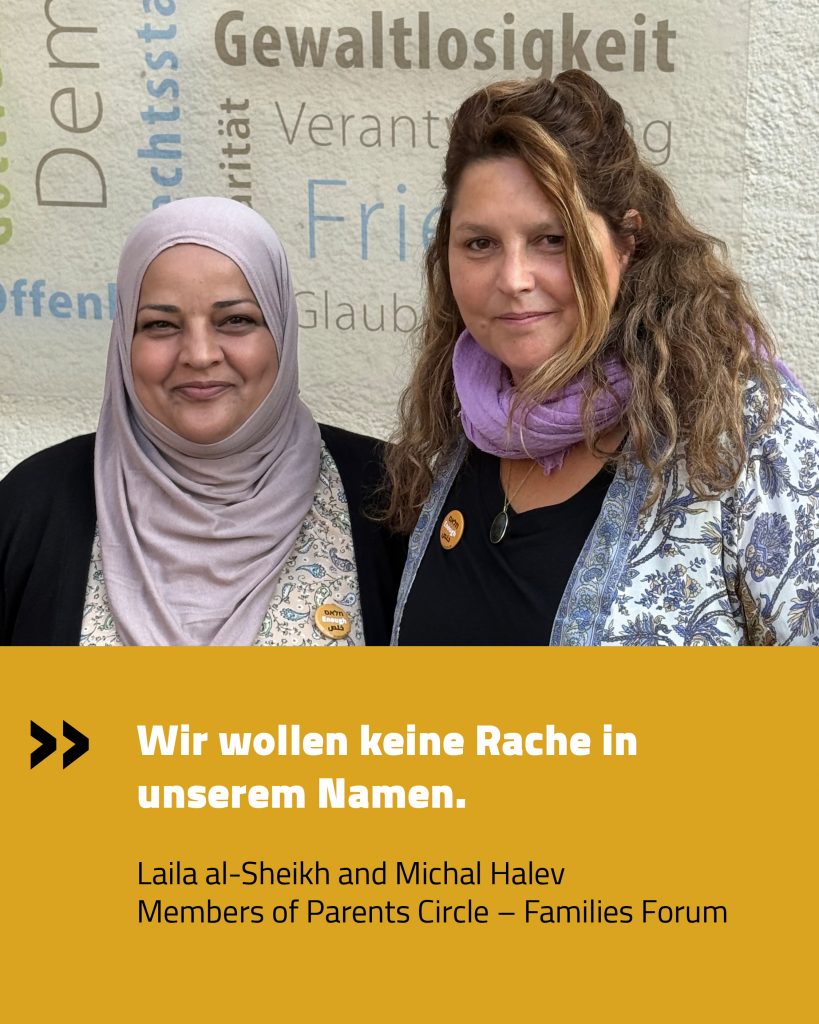
Two women stand at the front. Both wear the same small round button on their lapel. One word, in Hebrew, Arabic and English — and it means the same thing in each: Enough. The two women belong to the Parents Circle – Families Forum (PCFF), a Palestinian-Israeli peace initiative.
I know this from other evenings with the Parents Circle: it doesn’t take long before you see tears in the eyes of the audience. Not because the atmosphere is sentimental, but because what these people have to say reaches you immediately — directly, without detours, before you’ve had time to brace yourself. One of the women is Laila al-Sheikh, a Palestinian and a Muslim. The other is Michal Halev, an Israeli and a Jew. Both lost a son in the Middle East conflict. And both want their accounts of that loss to shake the world awake: the pain we feel is the same pain.
The following evening, Laila and Michal sit in front of an audience of around a hundred at the Protestant University Chaplaincy in Munich. Thomas Prieto Peral, Regional Bishop of the Evangelical Lutheran Church in Bavaria, moderates. Two evenings, two houses of faith, two very different Munich communities — and the same message: enough people have died. At the audience’s request, the evening opens with a minute’s silence for all the victims.
Laila’s son Qussay died in 2002, at six months old. During an Israeli army operation he breathed in tear gas; the family was denied access to medical care. Michal’s son Laor was murdered on 7 October 2023 — twenty years old, killed by Hamas at the Nova music festival.
Two mothers who would have every reason to hate. And who have nevertheless decided: not this way. And not in our children’s names.
I am moved every time I hear members of the Parents Circle – Families Forum speak. This Israeli-Palestinian organisation has existed since 1995. Every member has lost a close relative to war, occupation or terror. Around 850 families belong to it today; some 150 have joined since 7 October 2023 — each new membership a loss no one should have to bear. What this forum brings together is not a political programme but something far harder: shared pain.
At the end of 2024, the German friends’ association PCFD was founded. It supports the work of the Parents Circle – Families Forum by raising donations and by making its peacebuilding aims known in Germany, for instance through speaking tours like this one.
In 2025 the organisation received the Nuremberg International Human Rights Award. At the ceremony, and at the interfaith prayer for peace held by the Nuremberg Council of Religions to mark the occasion, the acclaimed actress Iris Berben paid tribute: “These are voices the media should be carrying very, very loudly.”
In 2026 the Parents Circle – Families Forum was nominated for the Nobel Peace Prize, which will be awarded on 10 December.
Laila was not part of it from the beginning. After her son’s death she lived with hatred for many years — sixteen of them, she says. Only then, through a friend, did she find her way to the Parents Circle. “Hatred and anger keep us from seeing each other as human beings,” she says now.
Laila describes an evening some years ago, at a dialogue meeting in Jerusalem. One Israeli man was weeping harder than anyone else in the room. When he stood up and began to speak, it became clear why: he had once been a high-ranking officer. He had served in Laila’s area. And he had stopped a vehicle carrying Palestinian children from reaching a hospital.
Laila says she didn’t know what to do. She burst into tears on the spot. The two of them were asked to leave the room and talk privately outside. Out there, the man said: “I know how hard this is for you. But I couldn’t hide this part of my story.” He told her that his own son had later fallen ill — and that he, too, had been held up at a checkpoint. The soldiers only wanted to ask a few questions, but he was in such a desperate hurry. In that moment, he said, he understood what he had done.
He resigned from the service, refused any further deployments, and went to prison for it. After his release he founded a peace organisation of his own, together with former Palestinian prisoners. They work to make Palestinian lives easier.
Even today it takes all of Laila’s strength to tell the story of that encounter, but today she is also grateful for it. The meeting helped her to forgive, even if it is a process that will never be finished:
“Forgiving doesn’t mean forgetting. I will never forget my son. But for me, forgiving means letting go of the hatred and the anger. Because they stop me from living. If even we can come together — we who are supposed to hate each other — then anything is possible.”
Laila puts the real purpose of the PCFF in personal terms: “I couldn’t save my son. But I can help make sure that the ones who are still alive grow up safe.”
Michal talks about the morning of 7 October 2023. About the first messages on her phone. About the word no mother wants to hear: missing. She describes the days of not knowing, the slow comprehension. Her son Laor was twenty. He loved music, wanted to bring people joy as a DJ; he was at the Nova festival as a guest. Laor was the joy of her life, she says, her only child. The news of his death broke her. Speaking about Laor, and campaigning for an end to the killing, is what has given her strength ever since.
Shortly after learning of Laor’s death, Michal recorded a video and posted it on YouTube: “No Vengeance in My Name. The Call of Michal Halev.” She spoke straight into the camera. Those two-and-a-bit minutes have been viewed millions of times:
“Stop all wars. Stop killing people. I don’t want revenge in his name. Let the people of the world come together to raise their children into loving human beings who can fulfil their dreams. Who can build a life and marry the love of their life.”
To Michal’s great sorrow, the war in Gaza began a short time later. So many innocent people have been killed. Today Michal Halev is grateful whenever she has the chance to speak about her son Laor, as she does at events held by the Parents Circle – Families Forum. Grateful because it may encourage people, in spite of everything, to commit themselves to peace now more than ever.
The Parents Circle stays active — even where the political situation barely allows it. Joint summer camps, once held in Israel or Palestine, now take place in Cyprus or Greece, because direct encounters between Israelis and Palestinians have become almost impossible. Zoom dialogues connect Israeli and Palestinian women’s groups when meeting in person is out of the question.
Asked how to deal with people whose views have hardened, the answer is: don’t argue. Don’t try to convince. Share your own story. Listen. Put yourself in the other person’s place, even when it hurts. “Sometimes you don’t need a long debate to move someone,” Laila says. “Sometimes a single moment is enough.”
Robi Damelin is also a spokesperson for the PCFF. She, too, is Jewish; she, too, lost a son to the conflict. At encounters like this one in Germany, she says a sentence that stays with you: “Don’t be pro-Israel or pro-Palestine. Be pro-solution.”
On the way home I think about the words at the entrance to the Munich Forum for Islam. Love. Community. Faith. And about that small button: Enough.
That, I believe, is the vision these women are speaking of. Not peace as a political agreement, but peace as a daily decision — a choice that has to be made afresh every morning, even when the pain doesn’t grow any smaller. Laila and Michal make that choice. Again and again.